




Understanding private equity portfolio operations compensation in 2026

Private equity firms employ portfolio operations teams to improve the performance of their investment companies.
Depending on the firm, these teams’ responsibilities may include developing growth strategies, improving operations, supporting transformations or applying specialized industry and functional expertise.
Portfolio operations roles provide an attractive career path for individuals from a variety of backgrounds, including consultants, investment bankers, operators or even private equity professionals who want to make a direct impact on multiple portfolio companies’ performance.
Compensation for portfolio operations leaders typically combines base salary and annual bonus, co-investment opportunity and carried interest in the fund, which is becoming more common as professionals advance.
The 2026 Charles Aris Private Equity Portfolio Operations Compensation Study draws on 199 responses from professionals currently working in these roles to provide a detailed view of cash compensation, carried interest eligibility and the experience that firms value when hiring these executives.
How much do private equity portfolio operations professionals earn?
Average cash compensation increases substantially with seniority*:
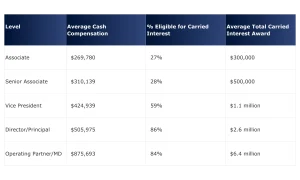
*Average carried interest figures include only respondents who were eligible for carried interest. They represent total carried interest across all vehicles, expressed as dollars at work (2x) rather than an annual cash payment.
Cash compensation includes base salary, annual bonus and automatic retirement contributions. At the end of the seniority spectrum, operating partners and managing directors earned most of their compensation by way of carried interest vs. cash compensation.
Carried interest is becoming more accessible
Carried interest isn’t universal, particularly at the associate and senior associate levels, but our findings indicate that more firms are extending it to professionals earlier in their portfolio operations careers.
Compared with our 2024 study, the percentage of respondents eligible for carried interest noticeably increased at several levels:
• Percentage of associates eligible for carried interest: 10% in 2024, 27% in 2026
• Percentage of vice presidents eligible for carried interest: 49% in 2024, 59% in 2026
• Percentage of directors/principals eligible for carried interest: 67% in 2024, 86% in 2026
This expansion may reflect growing competition for experienced portfolio operations talent. For firms, carried interest can help align value creation professionals with long-term investment performance while strengthening retention.
For candidates, it’s increasingly important to evaluate the structure of a carried interest award, including the vehicles covered, vesting schedule and expected timing of returns.
Do generalist and specialist portfolio operations professionals earn different amounts?
Private equity firms structure their portfolio operations teams in different ways.
Some rely primarily on generalists who can address a broad range of business challenges. Others hire industry specialists or functional experts in areas such as pricing, procurement, sales, technology or supply chain.
Among the 117 respondents who answered the study’s optional questions about role specialization, 15 identified as industry specialists and 21 as functional specialists.
The study found no significant difference in compensation among generalists, industry specialists and functional specialists.
Experience levels differed across the three groups (with industry and functional experts on average having more years of overall experience), but specialization alone was not associated with meaningfully higher or lower compensation.
How does prior experience affect portfolio operations compensation?
After normalizing the results by level, cash compensation was higher for respondents with several types of prior experience:
• C-suite experience: 21.8% higher
• Private equity deal-team experience: 11.8% higher
• Investment banking experience: 10.3% higher
Nearly all associate and senior associate respondents had prior strategy consulting experience. Although that result partly reflects the Charles Aris network, it also reinforces the continued demand for professionals trained in structured problem-solving, analytics and executive communication.
How does portfolio operations compensation compare with deal team compensation?
Portfolio operations and investment professionals perform different roles, but their compensation structures are becoming more similar.
Based on our work with private equity firms, investment professionals still tend to outearn their portfolio operations counterparts. However, the compensation levers remain largely the same, with base salary, annual bonus, co-investment opportunities and carried interest making up the majority of someone’s earning potential.
At some firms, while still the minority, portfolio operations and investment professionals are even on the same compensation structure.
It’s also worth noting that the compensation gap between the two groups has shrunk over the last few years. The increasing availability of carried interest among vice presidents, directors and principals supports this broader shift.
As portfolio operations teams become more directly accountable for investment outcomes, firms are creating compensation packages that better align these professionals with fund performance.
What the 2026 findings mean for firms and candidates
For private equity firms, the study reinforces the importance of benchmarking compensation by seniority, prior experience and incentive structure.
Firms competing for proven value creation talent may need to look beyond cash compensation and consider how carried interest and long-term career progression differentiate their offer.
For candidates, the findings show that portfolio operations continue to offer a significant financial upside. Professionals evaluating an opportunity should consider the complete package, including carried interest eligibility, vesting terms, the number of participating vehicles and whether co-investment is available.
As value creation remains central to private equity performance, competition for professionals who can turn strategy into measurable results is likely to remain strong.
SIMILAR ARTICLES
Meaningful conversations: How our deal-sourcing team connects with founders
We launched our transaction services business with the guiding philosophy that meaningful conversations lead to successful deals.
The new era of workplace wellness at Charles Aris
Throughout the past year, we’ve also integrated firmwide activities into our culture to promote healthy meditation, social events and exercise.
Charles Aris in the community
Our firm places a high value on giving back to our communities, and our team members have been working alongside several organizations to do so.